10 Questions to Ask Before Hiring a Family Historian or Book Designer
Commissioning a family history book is a significant decision. You're entrusting someone with the most personal material imaginable (your family's memories, photographs, letters, and stories) and asking them to turn it into something permanent.
The person or studio you choose will determine whether the result is a treasured heirloom or a forgettable volume that sits unopened on a shelf.
Before you sign anything, ask these questions. The answers will tell you a great deal about whether you've found the right partner.
1. Do You Conduct Original Interviews, or Do You Work Only From Material I Provide?
Some services are design-and-production houses: you hand them finished text and photographs, and they lay it out and print it. Others, like Plantain, provide skilled interviewers to sit with your family members, draw out stories, and capture voices that might never otherwise be recorded.
The richest family history books tend to come from a combination of both: your archives plus fresh oral histories conducted by someone who knows how to listen.
Ask this question early. The answer will tell you whether you're hiring a printer or a storytelling partner.
2. Who Does the Writing, and What's Their Background?
Some services maintain large networks of freelance ghostwriters and match you with one based on location or availability. Others work with a small, dedicated team who are deeply involved in the project from start to finish.
Neither approach is inherently better, but you should understand which model you're getting. A freelancer matched to you can bring fresh perspective, local knowledge, and a writing style well-suited to your story, and for many people, that works beautifully. But that writer will have a different relationship with your material than one who has spent months immersed in your family's archives alongside the designer and interviewer, absorbing the world of the story before writing a word.
Ask to see samples of their writing across different projects. Do the voices feel distinct, or does everything read in the same tone?
3. Is the Design Custom, or Do You Work From Templates?
This is the question that separates bespoke studios from production services.
A template means your book's layout, typography, and colour palette were designed once and reused across many clients. A custom design means the visual language is developed specifically for your story, drawn from your family's culture, personality, and archives.
When Plantain designed the Harts family book – a collection of short stories capturing the personalities of a colourful extended Trinidadian family – every aspect of the design was customised to suit the family's personality: colours, fonts, dimensions, bespoke illustrations, even the paper (Conqueror Cream Wove, chosen for its warm touch and high-contrast printing). Younger generations were specifically considered, so they could access their heritage in something they'd actually want to pick up. That kind of care can't come from a pre-existing layout.
If the studio can't tell you how the design of your book will differ from their last project, you're probably looking at a template.
4. Can You Handle Multicultural Stories?
Family histories, especially in diasporic communities, often span countries and cultural traditions. A family with roots in the Caribbean, West Africa, and London will need someone that understands how to honour those different worlds within a single narrative.
If your family's story crosses borders – and many do – ask how the studio has handled that before. Plantain has navigated stories that span Hong Kong and wartime Shanghai, New York, the Caribbean, colonial and post-independence East Africa, and the Windrush generation's journey from the Caribbean to England, where a young woman named Edrisse Perkins sailed by ship to the UK in the 1950s to pursue a career in nursing at a time when that path was far from easy. Cultural sensitivity in this kind of work has to be woven into the process from the beginning.
5. How Do You Handle Sensitive Family Dynamics?
Every family has them. The estranged or forgotten sibling. The contested inheritance. The story that half the family wants included and the other half wants left out.
A good studio knows how to navigate this. They've managed projects where multiple stakeholders have competing perspectives, and they have strategies for balancing those perspectives without sanitising the story into blandness.
Ask about their experience with complex family dynamics. Ask what happens when two family members remember the same event differently. A studio that shrugs and says "we just write what you tell us" isn't equipped for the real messiness of family history.
6. What Does the Physical Production Look Like?
A book designed for posterity should be made like one. Ask about paper stock, binding methods, cover materials, and printing process.
There's a significant difference between a book printed at a high-end press (with accurate colour reproduction, paper that has weight and texture, and binding that will hold together for decades) and one produced through a standard print-on-demand service.
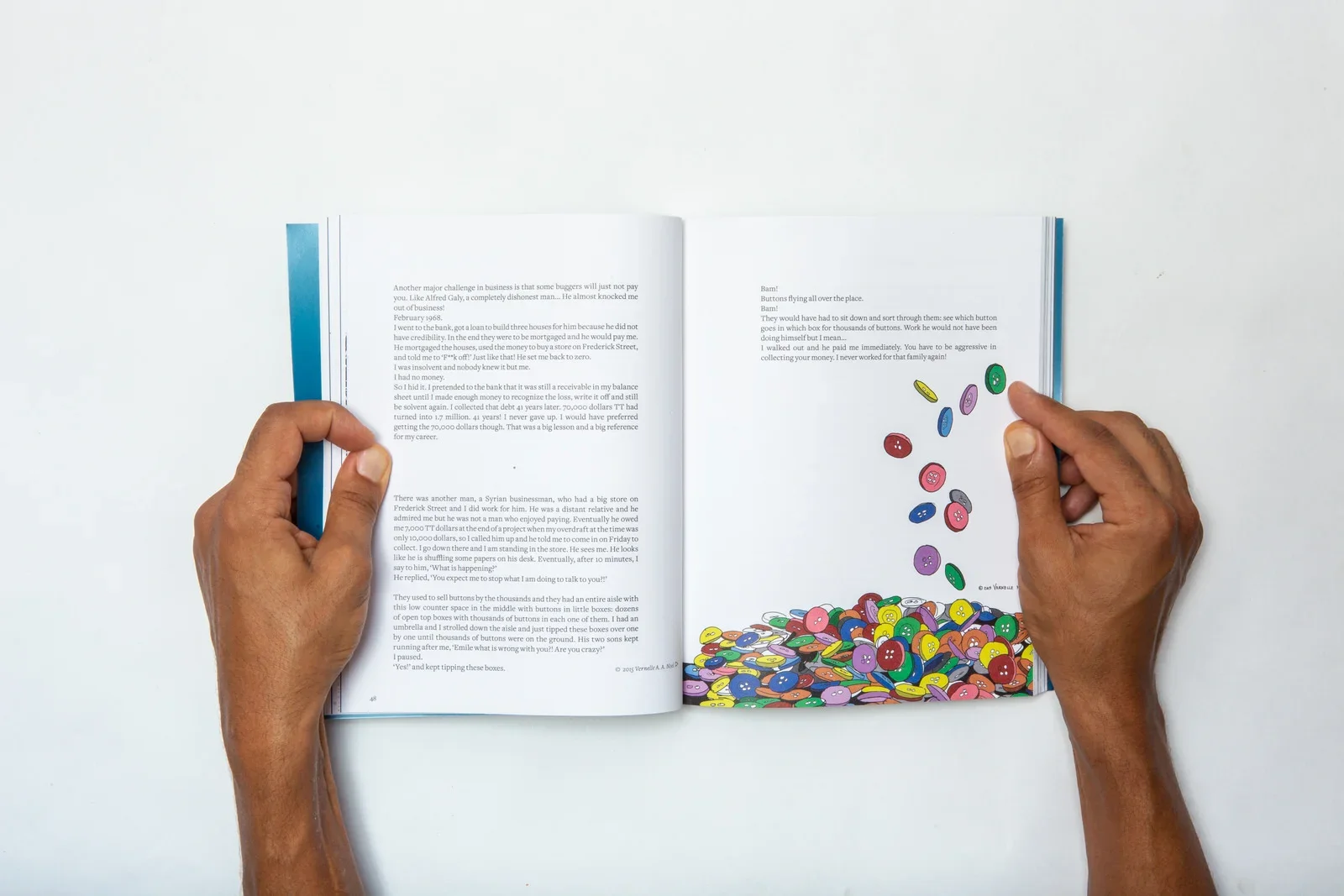
Plantain's portfolio includes books bound in hot toffee linen with copper foil, sapphire linen with red foil, grey linen with red print, matte hardcovers with custom artwork – each one customised to reflect the family’s or company’s personality. Material choices tell you something about the story inside.
7. How Do You Integrate Visual Archives Into the Design?
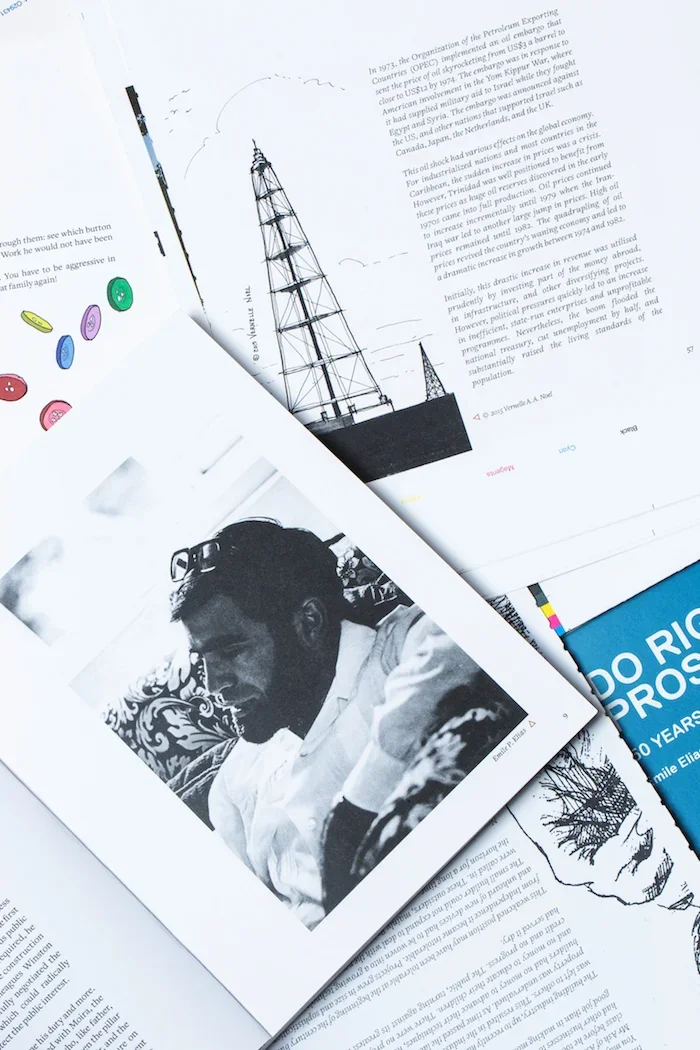
Photographs and documents in a family history book shouldn't be decorative. They should be narrative. A well-placed image sometimes does more than a paragraph of text to bring a person or a moment to life.
Ask how the studio handles archival material. Do they simply drop photos into designated slots in the layout, or do they curate and sequence images as part of the storytelling?
For The Poet Speaks – a tribute to the late poet Ruby Waithe, whose 76 poems and literary correspondence were discovered in a box after her passing – Plantain typeset the poems, but also created photographic scans of Ruby's favourite flowers, incorporated a hand-painted cover background by her granddaughter, included pink flowers picked by her great-grandson and son-in-law on the interior pages, and placed Ruby's original handwritten and typewritten pages alongside the typeset versions, because the emotion in her work lived partly in the hand that made it. That's a fundamentally different approach from inserting a grid of family photos between chapters.
8. What's the Typical Timeline, and What Affects It?
Bespoke family history books take time. Months. The interview phase alone can stretch over several weeks, depending on how many family members are involved and where they live.
Ask for a realistic timeline, and ask what factors tend to lengthen it. Common ones include: family members who are slow to respond, additional archival research that surfaces mid-project, and the iterative design review process.
A studio that promises a bespoke book in six weeks is either cutting corners or redefining "bespoke." A studio that tells you honestly that the project will take eight to twelve months (or more, for complex multi-generational histories) is telling you they do it properly.
9. Who Owns the Copyright and Materials?
Ask who owns the finished text, the design, and the archival materials after the project is complete.
In most arrangements, the copyright of the text should belong to the author (you or your family) once the book is completed and paid for. But the specifics vary between providers, and some services retain certain rights. Clarify this before you start.
Also ask what happens to the original archival materials you provide. How are they stored, handled, and returned?
10. Can I See Examples Across Different Styles and Subjects?
Any studio worth considering should be able to show you a range of past work: different families, different cultures, different aesthetic approaches.
If every book in their portfolio looks broadly the same, you're looking at a house style, not a bespoke service. The right studio should be able to show you a Caribbean family history that looks entirely different from a corporate 50th anniversary book, which looks entirely different from a Fortune 500 leader's memoir, which looks entirely different from a national railway history.
That range is the proof. It tells you the studio designs each book from the story outward, rather than fitting each story into a pre-existing mould.
Choosing With Confidence
The right partner for your family history book will answer all ten of these questions with specificity and enthusiasm. They'll show you examples, explain their process, and demonstrate that they've navigated the kind of complexity your project involves.
If you'd like to explore what working with Plantain looks like, browse our portfolio or get in touch. We're happy to answer every one of these questions… and any others you can think of.